

The Weight of What Comes Next: Mental Health and GLP-1 Medications
GLP-1 weight loss medications can lead to significant changes, but weight regain and mental health challenges are common after stopping. Understand what to expect and how to prepare for more sustainable outcomes.
Sarah lost 42 pounds in eight months on semaglutide. For the first time in years, her joints stopped aching, her blood pressure improved, and she felt hopeful about her health.
Then her insurance changed.
Within three months of stopping the medication, she regained 28 pounds. The physical change was difficult, but what caught her off guard was the psychological impact. The shame. The self-blame. The fear that she would never be able to maintain weight loss without medication.
Experiences like this are becoming more common, and research is starting to reflect what clinicians are already seeing. The conversation around GLP-1 medications cannot stop at weight loss. What happens after, and how someone relates to their body, food, and control afterward matters just as much.
The Reality of Weight Regain
GLP-1 receptor agonists such as semaglutide (Wegovy, Ozempic) and tirzepatide (Zepbound, Mounjaro) have significantly changed the landscape of weight management. These medications can lead to meaningful weight loss by reducing appetite, slowing gastric emptying, and increasing satiety.
While on the medication, the experience can feel like relief. Less hunger. Less preoccupation with food. More control.
What happens after stopping is different.
Research consistently shows that weight regain is common after discontinuation.
A systematic review published in The BMJ found that weight regain occurs progressively after stopping GLP-1 medications, with many individuals regaining a substantial portion of lost weight over time
Follow-up data on semaglutide showed that participants regained about two-thirds of their lost weight within one year of stopping treatment
Real-world data shows high discontinuation rates, with many individuals restarting medication due to weight regain
Why Weight Regain Happens
This is not a matter of willpower. It is biological.
GLP-1 medications enhance satiety and reduce hunger signals. When the medication stops, those effects stop.
At the same time, the body actively works to restore weight.
After weight loss:
Hunger hormones increase
Metabolism may decrease
The body becomes more efficient at conserving energy
This is part of the body’s regulatory system, often described as a “set point” range.
The body is not trying to sabotage progress. It is trying to maintain stability.
What Often Gets Overlooked
GLP-1 medications do not just change appetite.
They can also change how someone experiences:
Hunger
Fullness
Food decisions
Behavior around eating
For some individuals, this creates distance from internal cues. Hunger may feel muted. Fullness may feel unfamiliar. Eating becomes less guided by the body and more influenced by the medication.
For individuals vulnerable to disordered eating, this shift matters.
It can reinforce patterns such as:
Restriction that feels easier or more “successful”
Increased reliance on external control instead of internal regulation
Heightened focus on weight as a measure of success
These patterns are often subtle, but clinically significant.
The Mental Health Impact
The psychological effects of weight regain are often underestimated.
The Cycle of Hope and Disappointment
Many individuals begin GLP-1 treatment believing they will lose weight, build sustainable habits, and eventually maintain those changes without medication.
When weight returns, it can feel like failure.
This experience can reinforce weight cycling, which has been associated with increased psychological distress, including shame and reduced self-worth.
Identity and Body Relationship
Weight loss often changes how someone sees themselves and how they are perceived by others.
When weight returns, it is not just a physical shift. It can feel like a loss of identity.
For individuals who have tied progress, worth, or control to body size, this can be destabilizing.
Anxiety Around Food and Control
After weight regain, many individuals become more vigilant around food.
This can show up as:
Increased monitoring of intake
Fear of losing control
Rigid patterns around eating
Difficulty trusting hunger and fullness cues
These patterns can move closer to disordered eating over time.
Eating Disorder Risk
This is where clinical concern becomes more specific.
GLP-1 medications are not consistently screened for eating disorder history before being prescribed.
This creates risk.
Appetite suppression can make restriction appear “successful”
Reduced hunger can interfere with rebuilding trust in the body
Weight-focused outcomes can reinforce overvaluation of weight and shape
For individuals with a history of eating disorders, this can complicate recovery or contribute to relapse.
This is not always obvious at the beginning. It often becomes clearer over time.
Mental Health Is Not Optional in This Process
GLP-1 medications are often treated as a standalone solution.
They are not.
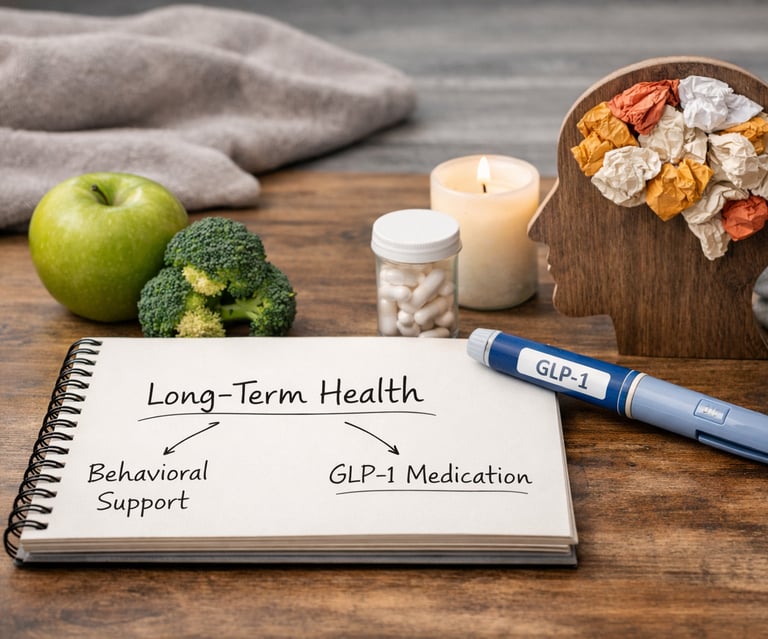
Research and clinical guidance continue to show that these medications are most effective when they are used alongside behavioral support that addresses eating habits, physical activity, and long-term patterns. Without attention to the psychological and behavioral side of eating, maintaining progress becomes much harder.
What Should Be Assessed Before Starting GLP-1s
A more complete approach includes understanding:
Relationship with food and patterns of eating
History of restriction, bingeing, or cycling
Body image and weight-related beliefs
Emotional regulation and use of food in coping
Expectations around weight loss and maintenance
Ability to respond to changes in appetite and body cues
The goal isn’t to screen people out.
It’s to understand what support each person needs going into this process.
Preparing for What Comes Next
One of the most important conversations often does not happen early enough.
What happens if the medication stops?
People benefit from understanding:
Weight changes after stopping medication are common and biologically driven
Hunger will likely return in a noticeable way
Ongoing support can help navigate changes in eating patterns and body shifts over time
When this is discussed early, people are often better prepared and less likely to feel destabilized if changes occur later.
A More Complete Approach
These medications can be helpful.
They can reduce constant hunger, improve metabolic health, and create space for change.
At the same time, they influence behavior, thinking patterns, and the relationship with food.
That is where behavioral health becomes essential.
The most effective care often includes:
Medical provider
Therapist
Dietitian
This supports both the physical and psychological aspects of the process.
Where Support Can Make a Difference
If you are considering GLP-1 medications, currently taking them, or thinking about stopping, it can be helpful to understand your readiness from a behavioral health perspective.
A structured assessment can help clarify:
How you currently relate to food and eating
Patterns that may affect long-term outcomes
Areas where additional support may be needed
How to approach this process in a more sustainable way
You can learn more here:
GLP-1 Treatment Readiness Assessment for Adults
What often determines long-term outcomes is how someone relates to food, their body, and the changes that come with it. Without that, even significant progress can feel unstable or difficult to maintain.
GLP-1 medications can be helpful, but they do not replace the need to understand patterns in eating, responses to hunger and fullness, and the factors that influence how someone eats over time.
When those pieces are addressed early, people are better prepared for the full course of treatment, including the possibility of discontinuation. That preparation often makes the difference between short-term results and something more sustainable over time.
Schedule Your
GLP-1 Treatment Readiness Assessment
Today


Online Adult ARFID Treatment in Florida, Washington D.C, Connecticut, Delaware, New Jersey, New York
NAVIGATE
SERVICES
CONTACT
Nourisesh © 2026
OFFICE:
100% Online